

Caption goes here. If you don't want a caption, type a single space in the caption field to make the image border show up.
This is Project Haruhi’s new review format for all media, be it video games, anime or manga. It’s designed to be short and strictly structured, meaning that you (as a reviewer) merely have to “fill in the blanks” rather than write an something overly long or complex. Remember, keep it short and simple. Make your point in as few words as as possible.
This introductory paragraph serves as a lead-in to the review. Use it to draw the reader in, mainly by stating any preconceptions you may have had going into this media, as well as briefly summarizing your overall opinion (which will be elaborated on later in the review). The main point of this paragraph is to get the reader interested and convince them to keep reading… so be bold and creative! In the words of the immortal Ms. Frizzle, “Take chances! Make mistakes! Get messy!”
The second paragraph will contain a brief plot summary of the media. Once again, keep it short and sweet. Remember, you’re giving your opinion, not a recap. Hit the main plot points to remind the reader of the media’s premise, but don’t get dragged down in the details. If this paragraph is longer than 200 words, you’ve written too much.
Read more after the break!
[break goes here]
This next section summarizes what you loved and hated about the media. Generally, you should have between 2 and 4 points for each category.

- Upload your screenshot as a full-sized HD-quality JPEG, insert it into the post, then manually resize it.
What I Liked
Biased Reviews: You may have heard people complain that a certain review is “too biased.” This claim is total BS. The entire point of a review is to offer an opinion for public consumption. Therefore, by their very definition, reviews MUST be biased. Don’t shy away from offering your honest opinion, no matter how harsh it may be.
Passionate Opinions: How did this episode make you FEEL? Did you laugh? Did you cry? Were the main characters sexy? Did you hate the art design? Be PASSIONATE in your writing! Express your feelings in bold terms! Make the reader feel what you felt!
Kickass Screenshots: When choosing your screenshots, stay away from talking heads or characters standing around doing nothing. Boring screenshots can be the death of a review; each image should convey emotion and intensity, so as to grab the reader’s attention and keep them glued to the screen. Example: this is a bad screenshot and this is a good one.
What I Hated
Bad Grammar: Here are a few things to remember. The following titles and names are always written in italics.
- A novel
- A ship
- A play
- A film
- A painting
- A sculpture or statue
- A drawing
- A CD
- A TV Series
- A cartoon series
- An encyclopedia
- A magazine
- A newspaper
- A pamphlet
The following titles and names are always written “in quotes.”
- Poem
- Short story
- A skit
- A commercial
- An individual episode in a TV series (like “The Soup Nazi” on Seinfeld)
- A cartoon episode, like “Trouble With Dogs”
- A chapter
- An article
- A newspaper story
When a media’s title ends with a punctuation mark of some sort (like K-ON!!), that mark cannot replace any regular punctuation in the sentence. For example, see how I end this sentence with the title Asobi ni Iku yo!.

The top screenshot should be resized to 640x360. The smaller screenshots are 355x199.
Too Much Japanese: If a media’s title has an official English translation, use it. Remember, the readers of this site speak ENGLISH. They’re much more likely to remember Occult Academy over Seikimatsu Occult Gakuin. Nobody wants to write Ore no Imōto ga Konna ni Kawaii Wake ga Nai when they could use My Little Sister Can’t Be This Cute instead. However, if it has a common Japanese abbreviation that makes the title easier to remember (such as OreImo or HOTD), it’s fine to use that informally. Just remember to italicize it.
Failure to Proofread: As a rule of thumb, it’s a good idea to proofread your work multiple times, using multiple methods. After you’re finished writing, go back and read the whole piece to yourself out loud. This will help you sense the overall flow of your writing, and catch any awkward phrasing. Delete any unnecessary words or phrases; in general, you want to convey your point in the simplest fashion possible. Flowery prose is a big NO.
After you’ve finished reading the piece yourself, send it to a friend for proofreading. They will be able to catch any mistakes you missed. Have them check both grammar and overall style. Solicit their feedback, and don’t be afraid of criticism. If you’re having trouble finding a proofreader, check the Haruhi Staff Chat on Skype. There’s usually somebody online.
Overall Summary
This section is where you weigh the positive against the negative and reach a final conclusion on the episode. Tie all your points together as best you can. Ask yourself, “Was this anime enjoyable, or were the flaws too severe? Did it make me want to keep watching? Can I, in good conscience, recommend this to my friends and fellow otaku?” Answer those questions here.
Rating
Project Haruhi’s new rating system is based around Picards. Using the corresponding image, you will award each episode between 1 and 5 Picards using the following criteria.
5 Picards: A superb episode. Whatever flaws it may have had did not detract from your enjoyment in any way.
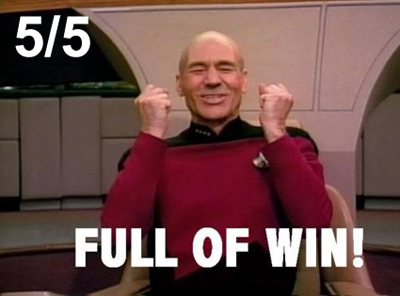
4 Picards: A good episode. It was enjoyable, but had some problems that noticeably lessened its quality.

3 Picards: A meh episode. It had good elements, but these were overshadowed by various problems. This kind of episode is neither good nor bad, but can still be enjoyable to genre fans.
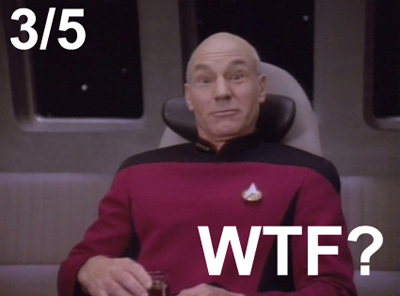
2 Picards: A bad episode. Cannot be considered good by any objective criteria, but might still be enjoyable in a “so bad it’s good” sense.
1 Picard: An unwatchable episode. The worst of the worst, bereft of any redeeming qualities whatsoever.
