
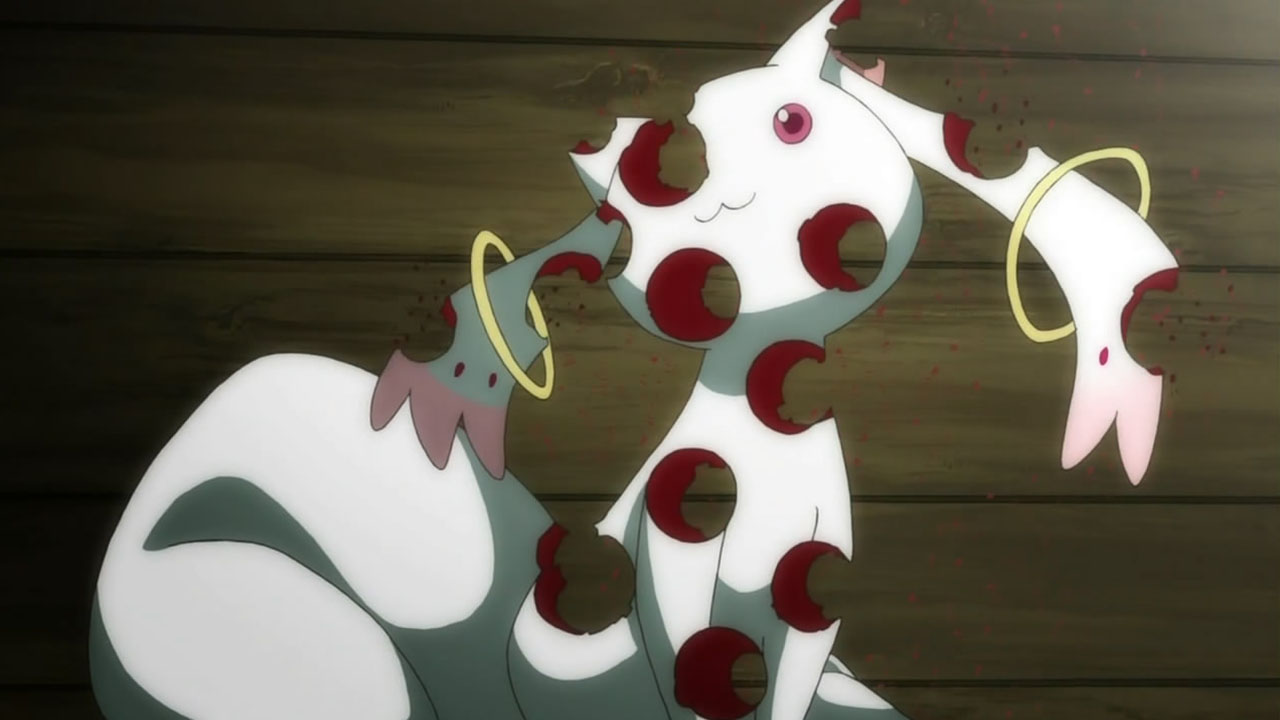
The only good emissary of evil is a dead one.
So, remember when I made that post a while back warning everyone that Kyubey was not to be trusted?
Well, guess what? I was right.
Maybe I had a bit of an advantage over my fellow Project Haruhi staffers, since I watched all six seasons of LOST. Maybe that experience made me far more willing to believe and attempt to validate crazy fan theories. Or maybe I’m just completely nuts and have lost all sense of rational thought.
Whatever the reasons, I totally called all the so-called “twists” in episode eight, and I’m going to break down how I did it.
[Warning! Spoilers lurk after the break!]
Let’s tackle the three big reveals in the order the show does. First:
Sayaka Becomes a Witch
Specifically, some fans believed the Gear Witch in the first episode’s prologue is Sayaka. And while the evidence was purely artistic, I thought it was pretty convincing. It wasn’t until the sixth episode, however, that I was certain Sayaka was doomed. I had two reasons for coming to that conclusion, both of them based in narrative theory.
The main reason was that Kyubey gave Sayaka a detailed explanation of the relationship between Soul Gems and Grief Seeds. In a story, if someone says, “If you do this, bad things will happen,” then you’re virtually assured to see the character who received that warning do that bad thing. It’s a pretty basic and effective foreshadowing method. Especially if you consider my secondary reason, which is: Sayaka was groomed to be a tragic figure. Remember when Homura implied that Mami made a wish for someone else and now regrets it? Sayaka did the same thing. In fact, this show has consistently shown that being selfish and cynical is a very good way to survive as a magical girl; and that having the opposite traits can get you killed. Like all Shakespeare’s tragic heroes, Sayaka’s downfall was–and has always been–hubris. She believed she knew better than everyone else, including the two girls who had far more experience than her. And if you know anything about Shakespeare, that means she’s destined to die.
Homura is a Time Traveler
This theory seemed obvious to me from the get-go, and usually had the most evidence backing it. In the first episode, for example, Homura seems to know exactly who Madoka is despite Madoka never meeting her. Second, she seemed to care specifically about Madoka not becoming a magical girl; after all, she didn’t go out of her way to stop Sayaka. That implies she somehow knows Madoka is special.
The huge tip-off, though, actually comes from Kyubey. In response to Kyouko asking who Homura is, Kyubey tells her that she made a contract with him, but also didn’t make a contract with him. Or to put it another way, he recognizes her powers as clearly coming from him but doesn’t recall ever making a contract with her. To me, this was as blatant an indication of time shenanigans as I was going to get until an exposition dump came along. Because if Homura made a contract near the end of the first iteration of the timeline and then went backwards, of course the “reset” Kyubey wouldn’t have memories of the contract. Basically, time travel became the simplest way to make sense of what Kyubey meant.
And yes, I am aware how odd it is to put the words “time travel” and “simplest” in the same sentence.
Kyubey is Evil
And so we come to the biggest–and most accepted–theory of them all. My first post on the subject already contained a lot of circumstantial evidence, but I lacked one crucial thing: motive. Why was he…she…it going through all the trouble of making magical girls just to turn them into witches? Seems a little overly elaborate, doesn’t it?
I finally got the piece of evidence I needed in episode six. If you recall, once Kyubey is done telling Sayaka about how Grief Seeds work, he tosses the thing into his back. He doesn’t destroy it. He consumes it. Or stores it. Either way, he doesn’t wipe it out of existence. Which means he still has a use for it.
And that use is for Walpurgis Night, which is also revealed in episode six. The German version of Walpurgis Night (which Madoka would most likely be referencing, considering the blatant allusions to Faust) is based on 15th and 16th century descriptions of Witches’ Sabbath. This Sabbath–and, by association, Walpurgis Night–are particularly special, because Satan himself was believed to walk the Earth during that night. The implication is clear: Kyubey is collecting Grief Seeds–concentrated sin, essentially–in order to summon Satan on Walpurgis Night. Kyubey needs to collect the corrupted souls of girls, because that’s either the only way or the most efficient way to power the summoning ritual. Or the birthing ritual. Or however it works in Madoka’s universe.
Regardless of how the specifics work out, I think it’s safe for me to say:
I told you so!