
Tax dollars at work
This odd mix of Japanese folklore, alternate historical fiction, and shoujo romance caught my eye almost immediately during the fall season previews. I can enjoy something from just about any genre, provided it’s well-written and has interesting characters, but I’m especially fond of unique sociological settings. However, I was curbing my enthusiasm to the best of my ability following some lackluster trailers which were released a few weeks prior to the series’ premiere. My primary concern was that the show would shelve its interesting premise and instead degenerate to a standard romcom, but so far that concern seems to be unfounded. Instead this is shaping up to be an intriguing metaphor for the westernization of Japan during the early Meiji era.
The episode wastes little time on introducing the show’s premise: the various groups of youkai (which I will refer to as ‘spirits’ for the sake of English) are having difficulty adjusting to the westernization of Japan and the new Gregorian calendar in particular. Therefore, the new Meiji government charters the Ministry of Spirit Affairs, which will employ both humans from the military as well as half-human spirits in an attempt to mediate relations and help them integrate into modern society. Hilarity ensues when it comes to light that Agemaki, one of the military officers assigned to the new department, is so terrified of spirits that he can barely keep his composure in their presence.
More after the break!
What I Liked
One of us... one of us...
The Setting: Japan adopted the Gregorian calender in 1873, just five years after the Meiji Restoration. Almost immediately following this change in government the country began racing to modernize and become more like the western countries which the former regime, the Tokugawa Shogunate, had feared and barred from entering the country. In this universe, the spirits, while coexisting with humans to a degree, are not favorable to this change which the Meiji government is pushing. From small things like drinking cow’s milk (gross) to the larger issue of dealing with open contempt and prejudice in public, it’s a place where refusal to change is not going to be practical much longer and the end of an era is passing. Seeing how the two elements of human and spirit will mingle and what will survive the violent cultural overhaul is something I’m looking forward to.
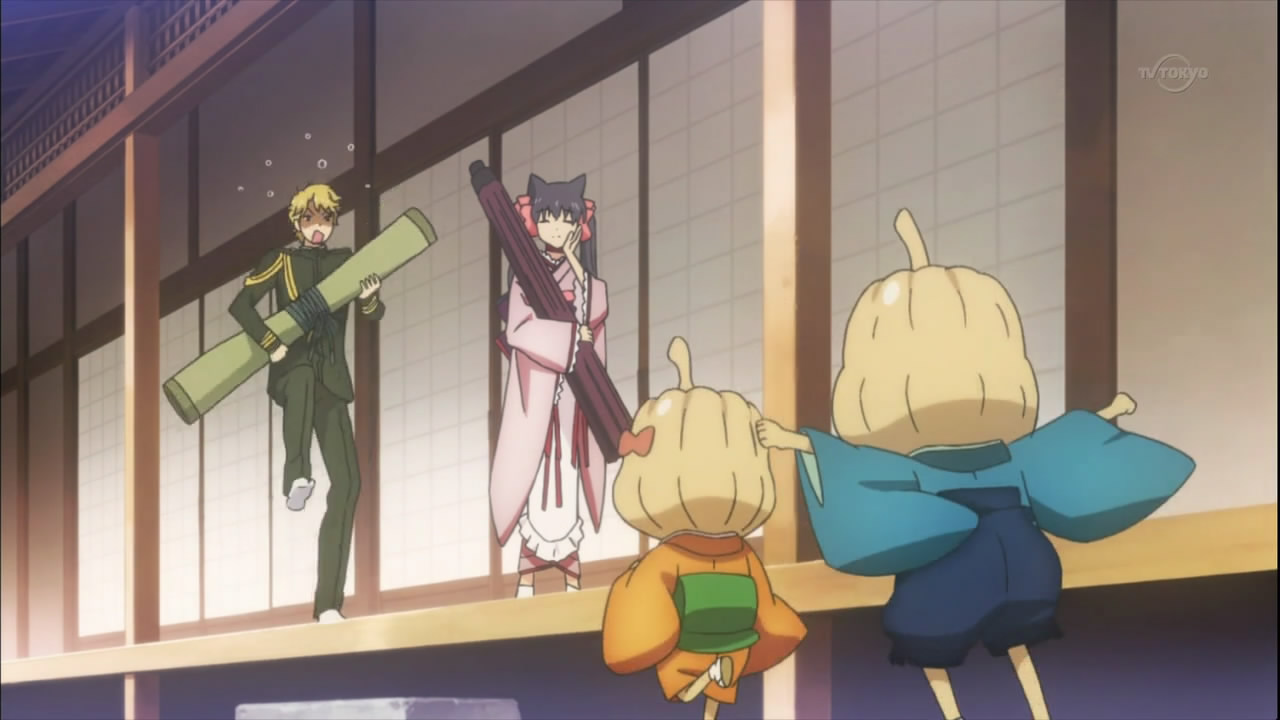
The Humor: While I wouldn’t classify this series as a comedy, it does know when and how to be funny. The main source of humor in this episode comes from Agemaki’s mortal fear of spirits and his attempts to play it cool for the sake of preserving diplomatic relations, appeasing his father, and so that everyone won’t find out he’s just a big chicken. This goes well at first, but after inappropriate greetings and running a gauntlet through the house of horrors in the middle of the night, he has a complete meltdown in front of his working partner, Zakuro. Embarrassed with herself for initially becoming smitten with his suave facade, she begins finding ways to embarrass and aggravate him in return. Although the humor is often silly, the show seems to have a good idea of how silly it can be without becoming insipid or ruining its ability to switch gears to a more serious note.
The Voices: The main cast for this show is surprisingly high-class: Mai Nakahara, Yui Horie, Aki Toyosaki, Takahiro Sakurai and Satoshi Hino each have dozens of leading roles under their belts; many of them from very popular works. Mai Nakahara in particular does an excellent job with Zakuro’s tsundere aspects. The scene in which Agemaki stumbles into Zakuro in the middle of the night is a good example of how she injects overtones into her character which can only be perceived through her voice: as she’s stammering nervously, her voice is breathy and a little seductive, which gives the impression Zakuro is only feigning resistance and wants the situation to progress further. Then, just a few seconds later, her voice completely shifts with a single syllable expressing surprise, disgust and bewilderment that actually had me laughing just from the delivery.
What I Disliked
She acts like it's squirted out of a cow's tit or something
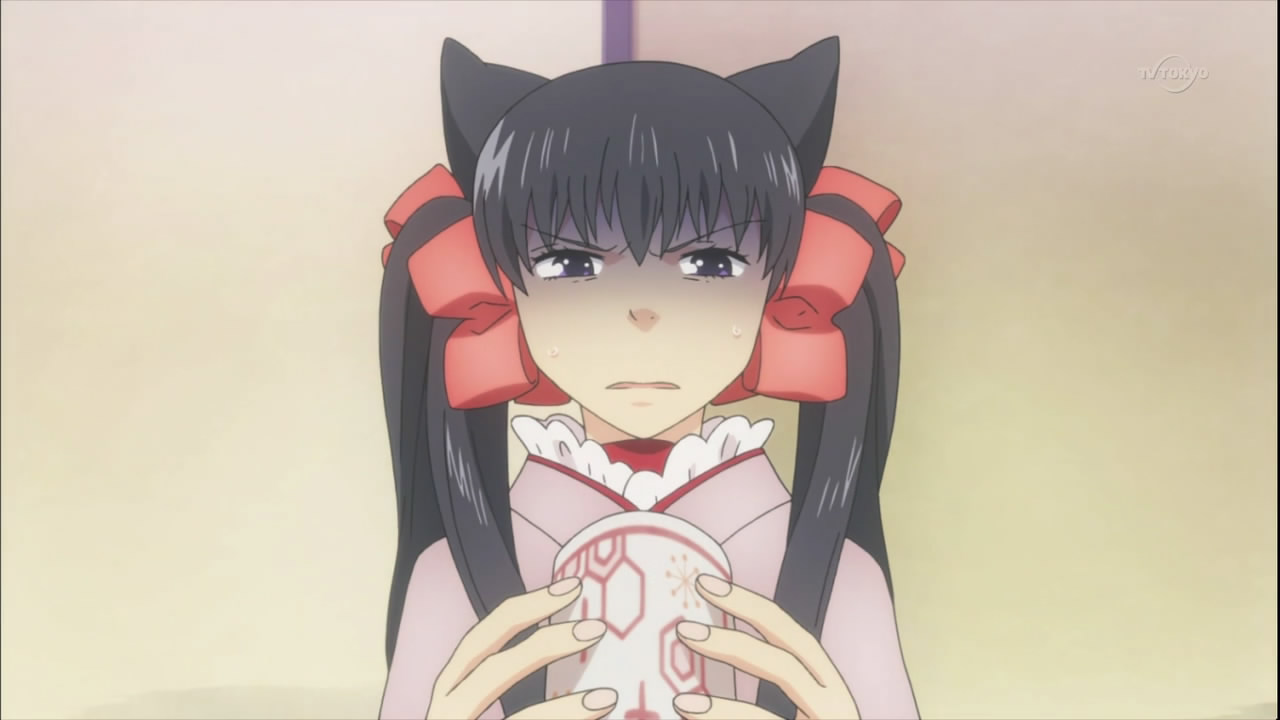
The Music: The background music for this show is very by-the-numbers: we have pseudo-passionate synthesizer music that accompanies Agemaki’s turning the charisma up to eleven, we have goofy staccato melodies for the humorous bits, and we have some acoustic guitar picking for a thoughtful scene. It’s not necessarily bad; there were a few moments I really liked what the music was doing, such as the extremely European string music which played over the milk scene, but on the whole the music was barely noticeable when it was playing. I think there’s a lot of room to play around with mixing traditional Japanese music and western music to great effect in a story like this, so it’s a bit disappointing that this aspect wasn’t developed as well as it could have been. The chanting during the battle scenes added a hypnotic, otherworldly atmosphere which I really liked, but I’m a bit worried about it becoming repetitive if it’s used too frequently.
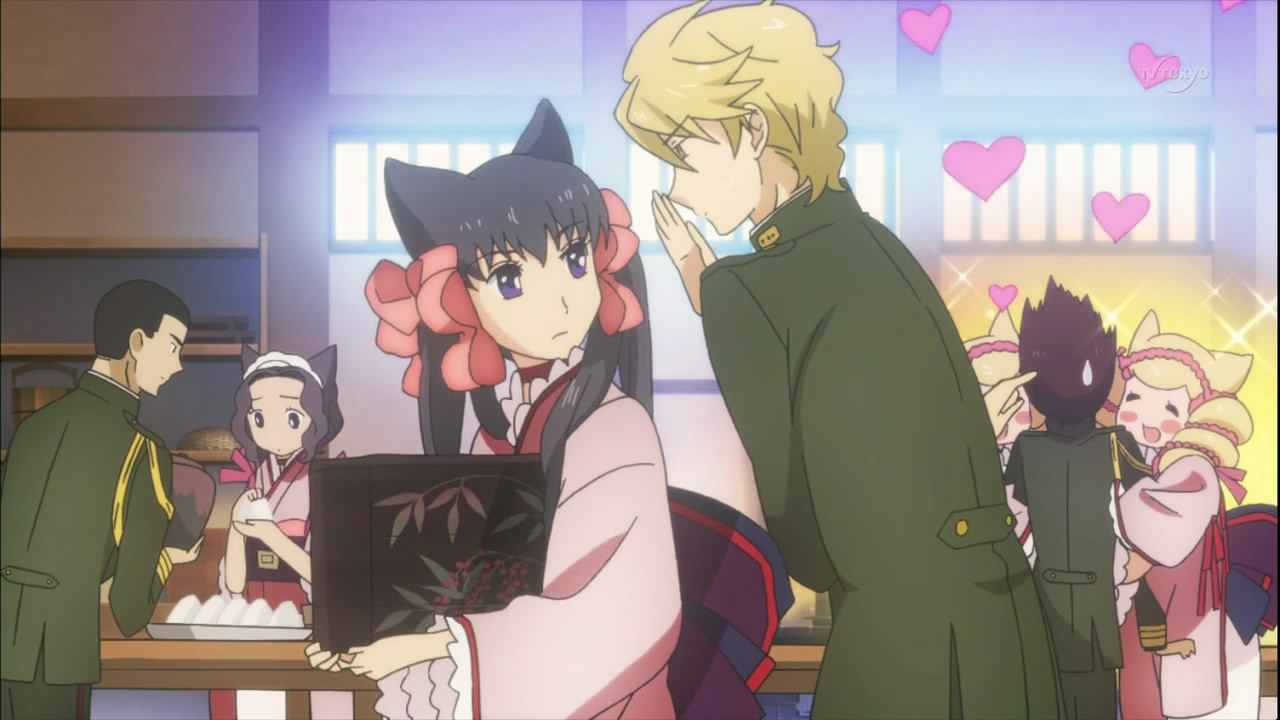
The Relationship Express: I probably don’t have to say anything more than that for anyone who watched the episode to know what I’m talking about, but for those that didn’t, this is basically what happens: the soldiers meet their half-spirit working partners and everyone is instantly romantically paired up or, in the twins’ case, triangled up or something. This is somewhat understandable in Zakuro and Agemaki’s case, since he’s meant to be attractive and he’s intentionally laying on the charisma so no one can tell he’s about to stain his pants, plus it’s one-sided and is quickly subverted, anyway. However, the twins basically go nuts for the little guy simply because he brags about his military rank and are hanging off him from that point on. Susukihotaru is initially intimidated by the gentle giant Yoshinokazura, but it’s pretty obvious from the start how it will play out and it more or less has completely before the end of episode. On one hand, I can appreciate not wasting time and dancing around feelings for an entire series when everyone knows where it ends up anyway, but with absolutely no previous buildup or deeper connection than that was who they happened to be standing opposite when they introduced themselves I just ended up with a bruise where my palm connected with my face.
Overall Impressions
The comical, contentious relationship between Zakuro and Agemaki and the way it parallels the larger cultural issues which the story handles are definitely the highlights of this show. If the rest of the cast can be similarly fleshed out and the tension surrounding the collision of cultures remains a strong focus alongside the characters it could be one of my favorite shows this season. Although the beginning felt rushed and unconvincing, this episode quickly piqued my interest and held it for the duration. This series motivated me to look up a lot of information on the Meiji Restoration, and as such I’d quickly recommend this to anyone interested in Japanese history and folklore as well as casual viewers looking for a cute romance story. Because of the dual levels of focus in the characters and the sociological aspects, this will appeal to a wide range of anime fans, but I think it may be a bit alienating to anyone not already familiar with the setting.
