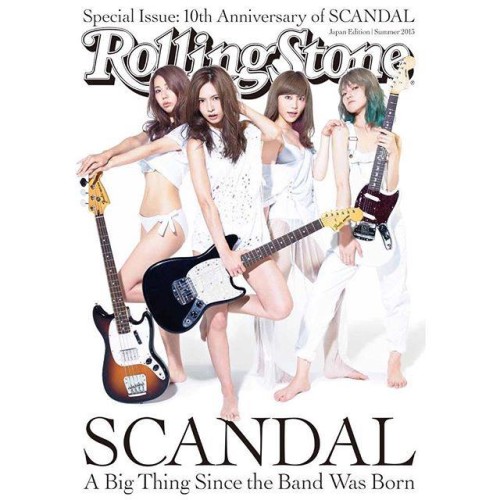
Left to right: Tomomi Ogawa (Bass / lead vocals) Haruna Ono (Lead Vocal / rhythm guitarist) Rina Suzuki (Drummer, Keyboardist, Guitarist, secondary vocals) Mami Sasazaki (Lead Guitar / secondary vocals)
A few years ago, I posted an article about the band Scandal. This is a follow up to that piece.
That last five years have seen aggressive yearly tour schedules playing every major arena in Japan–including BUDOKAN in 2012 and OSAKA-JO HALL in 2013–and then capping it off with the ‘HELLO WORLD Tour’ in 2015.
Congratulations SCANDAL, you’ve made it, and you’re on the cover of Rolling Stone. Granted it’s the Japanese Edition but in my book Rolling Stone is all that matters.
SCANDAL has taken advantage of modern technology, social media and YouTube, using self promotion that was not available when I was their age. I have to admit I’m quite amazed how all this self promotion works. And comparing today to the last post they were pretty much the only ‘all female band’. Today the number of bands has exploded. SCANDAL was the trail blazer for this generation of bands. A point of order here is the difference between a band and a group: in a band you play instruments, in a group you don’t. SCANDAL is a band. 9nine, AKB48, and Momoiro Clover Z are groups. Going back to my last post, the only semi popular female band that I found, believe it or not, was the live action K-ON band. A lot has changed in the past 5 years.
As most of you are aware, I enjoy many things in this life, and music is one of them. Music is also universal; you need not know the language to like what you hear. I’ve followed SCANDAL since 2008 and their first US appearance. So what do I like about this band? The simple answer would be the music, but there is more to it than that.
What makes SCANDAL stand out? You get a performance from the entire group, not one person monopolizing it. Granted, Haruna is lead vocal. She has the natural gift of leadership, and has learned how to best utilize the group as a whole.
A bit of history: SCANDAL was officially formed in 2006 on Rina’s 15th birthday. Mami and Tomomi were 16, and Haruna had just turned 18. Face it, keeping independent souls in that age bracket together and learning the ropes was a daunting task, I’m sure. Then–two years later–they’re here, in the states, performing. Yeah, there is some chemistry between the four of them I would say, with Haruna being the lead chemist.
That aside, the performances–live and studio–are first rate. They play their own music quite well, I might add, and are genuinely enjoying what they are doing. Take Haruna’s powerful vocals teamed with Tomomi’s hauntingly beautiful voice, then add in Mami’s and Rina’s background vocals and there’s the formula for listening pleasure. With all of this balance in instrumentals and vocals SCANDAL has hit the right note. (I should mention here that Tomomi was the lead vocalist on their first releases. Whoever is leading, the members follow with an excellent result.)
Congratulations on entering your tenth year together and here’s hoping for many more to follow…
And whatever course fate takes you on enjoy it to the fullest…
A belated Happy Birthday to Mami and Tomomi and a early Happy Birthday to Haruna and Rina…
Oh Rina, if you ever run out of arenas, let me know, I’ve got such a list.
(Addendum)
I just finished watching the P/V for Stamp. Besides being a great number, I might suggest that, in future, American cars need to have the door firmly pulled to you. Haruna made the effort but the Mustang only hit on the ‘safety’ latch. Just for future reference and while I’m at it, I’m waiting for ‘Sisters’ to be released. I’m hoping it follows the idea I have in my head.

![[gg]_Aku_no_Hana_-_01_[88C4AA88].mkv_snapshot_20.31_[2013.04.07_12.41.50]](http://www.projectharuhi.net/wordpress/wp-content/uploads/2013/04/gg_Aku_no_Hana_-_01_88C4AA88.mkv_snapshot_20.31_2013.04.07_12.41.50-e1365364880472.jpg)
![[gg]_Aku_no_Hana_-_01_[88C4AA88].mkv_snapshot_16.55_[2013.04.07_12.40.08]](http://www.projectharuhi.net/wordpress/wp-content/uploads/2013/04/gg_Aku_no_Hana_-_01_88C4AA88.mkv_snapshot_16.55_2013.04.07_12.40.08-e1365366718418.jpg)
![[gg]_Aku_no_Hana_-_01_[88C4AA88].mkv_snapshot_12.05_[2013.04.07_12.38.30]](http://www.projectharuhi.net/wordpress/wp-content/uploads/2013/04/gg_Aku_no_Hana_-_01_88C4AA88.mkv_snapshot_12.05_2013.04.07_12.38.30-e1365366758294.jpg)
![[gg]_Aku_no_Hana_-_01_[88C4AA88].mkv_snapshot_11.33_[2013.04.07_12.37.43]](http://www.projectharuhi.net/wordpress/wp-content/uploads/2013/04/gg_Aku_no_Hana_-_01_88C4AA88.mkv_snapshot_11.33_2013.04.07_12.37.43-e1365366830126.jpg)