Roundtable: Remembering Golden Sun

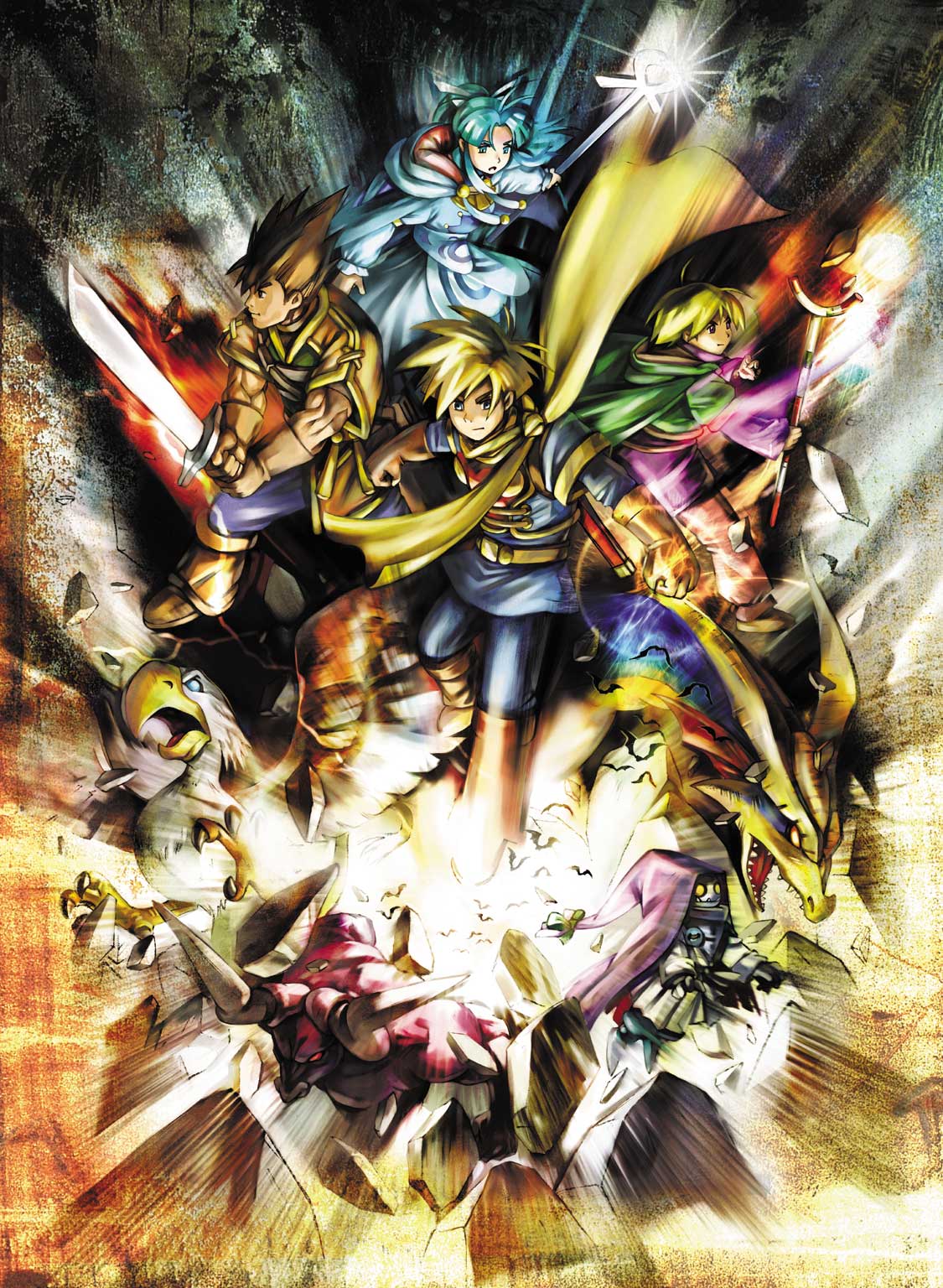
In 2001, Nintendo released Golden Sun, an RPG made by Camelot Software Planning for the Gameboy Advance. It took both critics and gamers by storm, quickly earning a devoted fanbase. Its 2003 sequel, Golden Sun: The Lost Age, met with similar praise and solidified the series as one of the best on the GBA and a must-have for RPG fans. However, it’s cliffhanger ending also left fans clamoring for a third game. Their hopes were met with little more than teases.

Finally, at E3 2009, Golden Sun DS–now titled Golden Sun: Dark Dawn–was revealed. As the resident Golden Sun fanatics, SilentAki and I can’t wait for its North American release, which is just a little over a month away. Since both of us recently replayed the first two games, we decided to meet on Skype to discuss what made Golden Sun such a great series. So if you want to join us on our trip through nostalgia lane or simply learn what all the fuss is about, follow us after the break.

But be warned: there are SPOILERS ahead!

Continue reading

I’m Not Sure What to Expect From a K-ON!!! Film

Editorial Comment

The final K-ON!! episode announced that a film will be produced. I can’t say I’m surprised, but I am somewhat disappointed. Do we really need this?

KyoAni has done it again: they gave us a repetitive and boring second season that didn’t live up to the first, just like Haruhi, and then tried to win back our favor with a film announcement. Bah! Why waste our time and money with a subpar TV anime season when KyoAni can give us better material on the big screen? MERCHANDISE is the answer. It’s all for one and one-thousand yen for a Mio doll.

Is this the future of anime? Do the studios care about nothing but merchandise and ticket sales? Substance, story and plotline don’t matter anymore? I certainly hope not… but given what I’ve seen lately, it’s hard to be optimistic.

I’ve said on the podcast that K-ON! had all the material to do a third season, provided it focused on the light music club and its new members. Will this film be about Yui and company, or the new band under Azusa’s tutelage? Will the girls finally realize their dream of playing at Budokan, or just sit around drinking tea? If this just winds up being more of the same pointless filler we got for much of the second season, they just shouldn’t bother making this film at all.

Here’s to the K-ON!!! movie. I hope you live up to the hype.

What You Should Know About Iron Man

With the first episode of Madhouse’s Iron Man on the horizon, some of you might be wondering, “What’s the big deal?” And I understand. Comics–with their high issue counts, many crossovers, and daunting pool of titles–can be tough to get into. I was once like you until I took the plunge. But now I’ve been buying comics every week for two years, and have acquired much knowledge of their characters. I pass this on to you, dear reader, so you may understand my excitement. Because, to be frank, Tony Stark is awesome.

Consider this a newbie’s guide to the life of Iron Man: everything you need to know (and more) before you watch Madhouse’s anime adaptation.

Continue reading

Don’t Panic! Analyzing the Decline of Anime

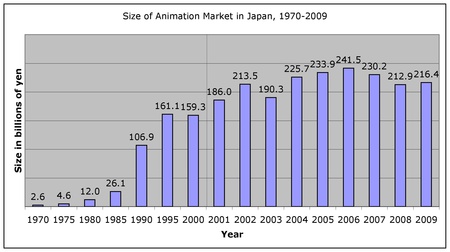
Many people have been talking about the the recent lull in the anime industry, both in Japan itself and abroad. The question is, does this lull spell the doom of anime as some have predicted? Or is it just a temporary setback for an industry that’s too mighty to perish? Well, to answer this question, we need to take a good look at the history of anime. This is an informative ANN article giving a good overview of the size of the anime industry over the last forty years. Of particular interest is this chart, a bar graph representing the growth of the industry since 1970.

What is quickly noticeable is the big boom around 1990, which is the time conventions began popping up in the United States and also when series like Tenchi Muyo and Ranma ½ were being released. Again, the industry sees another impressive climb by 1995, which is when Neon Genesis Evangelion and Ghost in the Shell were released. Moving into the new century, anime received increased exposure on cable television in the United States in the form of Toonami, which featured Sailor MoonDragon Ball Z and Gundam Wing starting in the late 90’s, and Adult Swim with Cowboy Bebop, Trigun, Lupin III and FLCL into the early 00’s.

Many of these shows were critically acclaimed and financially successful in North America and the volume and quality of anime being produced and subsequently licensed overseas saw something of a golden age, noticeably peaking in 2006 at nearly 220% higher than just 11 years prior. The future of the industry was bright, many series were being licensed for North America before they even finished their initial television run in Japan, and it seemed like the world couldn’t get enough of Japan’s fastest growing cultural export.

But could the industry maintain that unprecedented success? Find out more after the break!

Continue reading

The Confessions of Aya Hirano

Editorial comment


Here I was hoping Aya was on the road to normalizing her career, but that notion seems to be in my dreams. In reality, her career is becoming a large looming uncontrollable nightmare. Her recent revelations about her love life have caused quite a stir among her fans, creating lots of unnecessary and ultimately harmful drama. How Aya is coping with this is something we’d all like to know.

More after the jump. Continue reading

Is Anime Doomed?

Editorial Comment

Could we be living in the last days of anime? One industry insider seems to think so.

This article featured on ANN is from an interview with writer Dai Sato, credited with writing episodes for Cowboy Bebop and Ghost in the Shell. He paints a rather grim picture picture of the decline and death of anime within the next few decades.

Sato dismissed the idea of “Cool Japan” and complained that much of the in-between animation work in anime is outsourced to people in other countries, who may not be aware of or invested in the work itself. Similar to director Hayao Miyazaki, Sato criticized politicians and other who promoted the image of Cool Japan for their own purposes. Sato also decried series that were more about escape than about confronting real problems, and proclaimed that the anime industry in Japan is a “super establishment system” rather than a creative force, focused more on characters and on merchandise. He suggested that manga was “the last hold out,” and that if manga was lost then anime would not last without it.

While this reflects one person’s opinion, there are others who think the industry is growing. However given the subpar offerings for the summer 2010 season I can understand the reasoning behind Dai Sato’s statements.

Read my own opinion on this after the break.

Continue reading

The Four Laws of Moe

Is this moe's true form?

This is a refined and expanded version of an editorial I originally wrote for Japanator. The original can be found here.

It seems one of the biggest problems in the ongoing moe debate is the lack of any concrete definition for the term “moe.” This has lead to all sorts of argument among otaku; some believe the term can be applied to any female character the viewer considers cute, while others argue it should be strictly limited to its original Japanese definition. Personally, I think the truth lies in between these two extremes. After all, language is defined by its usage, not by the opinions of a few crazed fanboys or some dusty old dictionary. Therefore, based on my own observations and research, I have created the Four Laws of Moe. I believe these laws lay out, in clear and concise detail, the exact parameters of moe and what traits a character must exhibit in order to be considered as such. Of course, these laws are merely a reflection of my own opinion; feel free to improve upon them, argue against them or even construct your own alternative theory. Whatever the case, I’d love to hear your thoughts in the comment section below.

Read more after the break!

Continue reading

The Melancholy of Aya Hirano

Editorial Comment

Hysterical Barbie

Fame is a strange bedfellow: some handle it as if it were part of life, and for others it becomes a daunting pillar which they spend their entire life trying to stand upon. Aya Hirano burst on to the world stage a mere four years ago at the age of 18 when she voiced Haruhi. Since that time she’s moved on to a singing career, reprized her Haruhi role several times, was Konata’s voice in Lucky Star and has been searching for her real self in real life.

What is real life you ask? It is that life not on the stage, nor in the studio, those nights sitting in front of a mirror trying desperately to figure out what to do next. There are usually thoughts of “Who am I?” or “How did I manage to get into this dilemma?”

It is the opinion of this writer that Ms. Hirano is suffering a massive identity crisis. Her sudden unexplained illness, canceling of appearances, and hair loss all point to this. Furthermore, the rather garish appearance of her latest album (pictured above) in which she’s adopted yet another unnatural hair color after she promised she would return her hair to its natural color (black), seems to support this conclusion.

More after the jump.

Continue reading